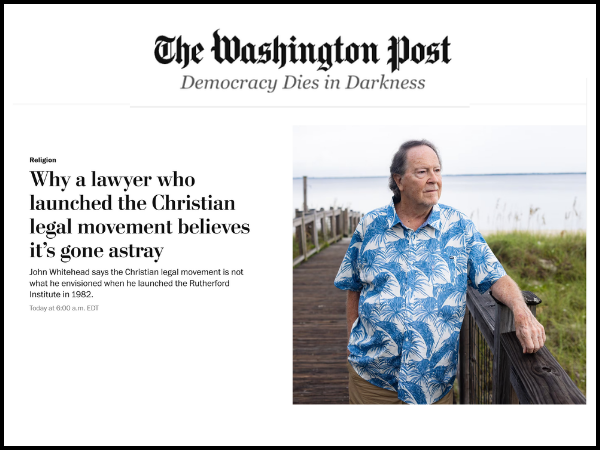
For the past several months, The Washington Post has been interviewing John W. Whitehead about a chapter of The Rutherford Institute’s history that stretches back more than four decades and his role in helping to launch what became the modern religious freedom legal movement in America.
It is a complicated story—and an important one.
When John began this work, the principle was simple: religious freedom belongs to everyone.
It belongs to Christians, Muslims, Jews, atheists and people of every faith and no faith at all.
It cannot depend on which political party is in power, which religion is culturally dominant, or whether we agree with the person whose rights are being threatened.
That principle has guided The Rutherford Institute through decades of cases defending people across the religious and political spectrum.
Over time, however, parts of the religious liberty movement have become increasingly entangled with partisan politics, Christian nationalism and the pursuit of government power.
That is not religious freedom.
Freedom of conscience means very little if we defend it only for people who think, worship or vote as we do.
After more than 40 years of defending constitutional freedoms, one lesson remains constant: All freedoms hang together.
If we allow the government to decide whose beliefs deserve protection—and whose do not—none of us will remain free for long.
“The old law of an eye for an eye leaves everybody blind. It is immoral because it seeks to humiliate the opponent rather than win his understanding; it seeks to annihilate rather than to convert… It creates bitterness in the survivors and brutality in the destroyers.”—Martin Luther King Jr.
We have been ambushed.
We should be talking about the dangerous, destabilizing things being done to this country.
We should be talking about the government’s growing network of detention centers and its family-separation policies, which have resulted in an estimated 145,000 American children experiencing the detention of at least one parent—including more than 22,000 U.S.-citizen children whose entire household of co-resident parents has been detained.
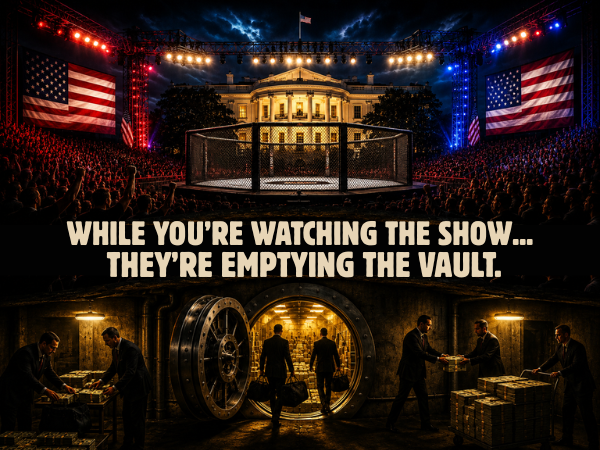
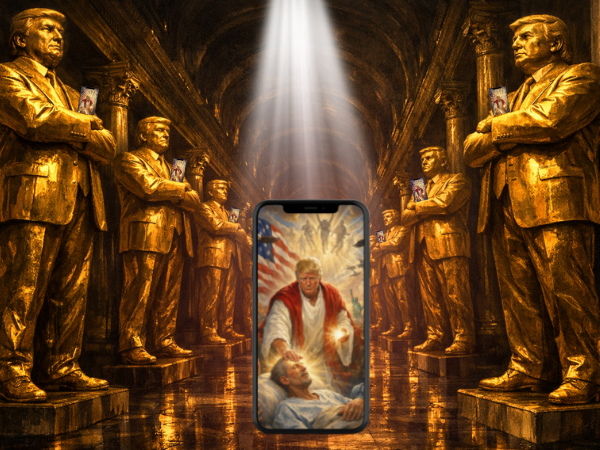
Every day—sometimes every hour—brings another outrage, another threat, another vulgar display of power, another self-glorifying meme, another political provocation and another distraction demanding our attention.
Before we can fully comprehend one assault on the Republic, another takes its place.
That is not merely the chaos surrounding this government.
It is one of the ways this government maintains power.
Keep the public angry, exhausted, frightened and distracted. Force everyone to chase the latest outrage. Crowd out serious scrutiny with political theater. Then push past another constitutional boundary while no one is able to keep track of what has already been lost.
This is how every crisis appears fleeting and every constitutional violation merely the latest controversy in an endless political spectacle.
Taken together, however, these are not isolated events.
They are tests.
Donald Trump is not defending the Constitution. He is testing how much of it he can violate before anyone stops him.
He is testing whether a president can wage war without Congress. He is testing whether federal power can be turned into personal power. He is testing whether dissent can be punished without formally outlawing speech. He is testing whether masked government agents can operate as a secret police force beyond public scrutiny and constitutional accountability. He is testing whether the government can watch, track and profile everyone without meaningful limits. He is testing whether the Twenty-Second Amendment, which limits a president to two terms in office, means what it says.
Most of all, he is testing how much abuse the American people will tolerate before exhaustion, fear, distraction and partisan loyalty wear down their willingness to resist.
That is the real constitutional crisis confronting America.
Trump has turned constitutional government into a continuous test of submission: He pushes beyond a boundary and waits. Will Congress resist? Will the courts intervene? Will government officials refuse? Will the public object? Or will everyone retreat, rationalize, delay and adjust?
If no one stops him, the violation becomes precedent. Then he pushes farther.
This is how a republic is dismantled—not necessarily through one dramatic declaration of dictatorship, but through a succession of constitutional violations that go unanswered long enough to become the new normal.
The administration’s approach to war offers a revealing glimpse into the instincts driving much of its conduct.
Asked about Iran’s promise to retaliate according to the principle of “an eye for an eye,” Secretary of State Marco Rubio declared that Trump’s policy is “a head for an eye.”
Not proportionality. Not restraint. Vengeance to the maximum.
The impulse behind that doctrine—to retaliate when challenged, punish when criticized, escalate when restrained and push harder when the law says no—is not confined to the battlefield. It runs through the administration’s approach to political opponents, dissent, immigration enforcement, executive power and constitutional limits.
“A head for an eye” may be Trump’s philosophy of war, but it is also a warning about the kind of government that philosophy produces. The result is a government at war not only with foreign enemies but with dissent, privacy, due process, constitutional limits—and ultimately with the American people.
Meanwhile, as the administration tests how much damage it can inflict and how many boundaries it can cross without consequences, the public is being overwhelmed by a relentless barrage of noise, spectacle and manufactured outrage.
And the costs of the government’s recklessness continue to mount.
The war with Iran continues to consume lives, military resources and tens of billions of taxpayer dollars.
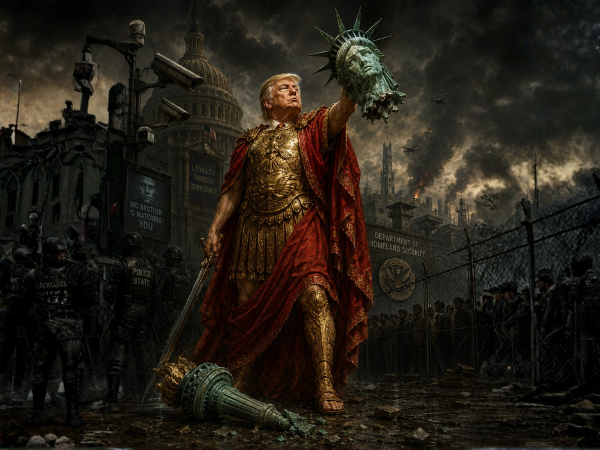
The sums spent on banners and gilded statues may be small compared with the cost of war, but their symbolism is impossible to miss. They reveal the priorities of a government that increasingly treats public money as a fund for war, political propaganda, personal glorification and imperial spectacle.
Meanwhile, Trump golfs, circulates self-aggrandizing artificial-intelligence memes, demands praise and continues to treat the presidency as though it were a personal brand rather than a constitutional trust.
This is what government without constitutional limits looks like: war without accountability, policing without transparency, surveillance without warrants, propaganda without shame and power without restraint.
America does not need another political slogan. It does not need to be made great again, stronger again, feared again, richer again or more powerful again.
America needs to be made free again.
Free from a government that tracks everywhere we go, treats dissent as dangerous, wages war without accountability, polices communities like occupied territory and insists that constitutional rights must yield whenever those in power invoke national security.
The question is no longer whether the Constitution is welcome in America. The question is whether the government still considers the Constitution binding at all.
By all indications, the answer is no.
Trump’s war with Iran is testing whether a president can bypass Congress, wage war on his own authority and force the country to absorb the consequences afterward.
So far, the answer appears to be yes.
The Constitution gives Congress—not the president—the power to decide whether the country goes to war. Yet each time Congress funds an unauthorized war rather than stopping it, presidential lawlessness becomes more firmly entrenched. Each time the courts decline to intervene, executive war-making becomes harder to challenge. Each time the public becomes distracted by the latest spectacle, another constitutional boundary disappears.
It is a government organized around war: war abroad, war at the border, war in the streets, war on dissent, war on privacy, war on poverty’s victims and war on anyone who refuses to fall in line. Every crisis has become an excuse to expand government power. Every enemy becomes a reason to weaken constitutional protections. Every emergency becomes permanent.
Trump is also testing whether federal power can be transformed into personal power.
The Constitution requires presidents to faithfully execute the laws. Trump demands that government officials faithfully execute his will. He has surrounded himself with loyalists, purged or sidelined officials who might resist him, treated independent oversight as insubordination and demonized critics as enemies.
The danger is not merely that Trump possesses enormous executive power. It is that the government increasingly treats loyalty to Trump as interchangeable with loyalty to the country.
That is how constitutional government gives way to personal rule.
Public servants cease to ask whether an order is lawful and begin asking whether it pleases the president. Agencies cease to serve the public and begin protecting the ruler. Independent oversight becomes sabotage. Disagreement becomes disloyalty. Resistance becomes treason.
Trump did not create the imperial presidency or the American police state. He inherited them.
Republican and Democratic administrations spent decades building the machinery he now commands: emergency powers, mass surveillance, militarized policing, executive war-making, government secrecy and a sprawling bureaucracy accustomed to operating beyond meaningful accountability.
Each administration inherited dangerous powers from the one before it. Each promised that those powers would be used responsibly. Each left the government more powerful and the people less free.
Trump’s particular danger is that he has seized this machinery, expanded it, personalized it and stripped away much of the pretense that it exists for anything other than power and control.
He is testing whether dissent can be punished without formally outlawing speech.
The First Amendment remains on paper. Americans are still legally permitted to criticize the government. Yet the administration does not need to repeal the First Amendment if it can make exercising those rights sufficiently dangerous. It can investigate critics, threaten opponents, pressure universities and law firms, target protesters, intimidate journalists and brand dissenters as enemies of the state. It can exploit the vast surveillance apparatus already in place to identify who attends a protest, visits a controversial website, associates with an unpopular group or travels to a politically sensitive location.
This is where the test of dissent merges with the test of surveillance.
The government no longer needs to assign an officer to follow you.
Your phone, your car, your face, your purchases and your digital associations do the reporting for it. License-plate readers, facial recognition, geofence searches, social-media monitoring and artificial intelligence can assemble detailed profiles of people never suspected of a crime.
The danger is no longer simply that the government can watch everyone. It is that an administration demanding personal loyalty possesses the machinery to identify, track, intimidate and retaliate against those who refuse to submit.
Speech does not have to be formally outlawed when people can be frightened into silence.
Trump is also testing whether federal agents can operate beyond constitutional and public accountability.
Immigration enforcement has become the proving ground for this authoritarian model of policing. Yet government powers do not remain confined to their original targets. Once the government claims the power to hide agents’ identities, conduct militarized raids, track people through vast databases and detain them without meaningful due process, those powers will eventually be turned on others.
Today, the target may be an undocumented immigrant. Tomorrow, it may be a protester, journalist, gun owner, government critic, parent, medical patient, religious minority or anyone whose movements and beliefs trigger an algorithmic warning.
The test is whether Americans will accept government lawlessness when it is directed at people they have been taught to fear or despise.
If they do, the precedent will be waiting when the government chooses its next enemy.
The Constitution could hardly be clearer: no person may be elected president more than twice. Yet Trump continues to flirt with the possibility of remaining in power beyond two terms, while allies float amendments and theories for circumventing the prohibition.
These provocations are often dismissed as jokes, trolling or political theater.
That is a mistake.
Authoritarians rarely begin by announcing that they intend to dismantle constitutional government. They float an idea, repeat it until it sounds less shocking, ridicule those who take it seriously and wait for the public to grow accustomed to the possibility.
Trump is testing whether an explicit constitutional prohibition can be weakened through repetition, rationalization and partisan loyalty.
He has mastered the art of accusing others of what he is doing, has already done or may be preparing to do. He accuses others of weaponizing government while turning federal power against his critics. He accuses others of corruption while treating public office as an instrument of personal enrichment and political reward. He accuses others of censorship while seeking to punish speech he dislikes. He accuses others of lawlessness while treating the Constitution as something to evade whenever it obstructs him.
So when Trump repeatedly warns that elections are being “rigged” or “stolen,” we should pay close attention.
The question is not merely whether he is repeating old grievances about 2020. The question is what those accusations are conditioning the country to accept in 2026.
Are they preparing supporters to reject results that cost Republicans control of Congress? Are they laying the groundwork for federal intervention in elections traditionally administered by the states or for emergency actions carried out in the name of “election integrity”?
These are not far-fetched concerns.
Trump has an enormous personal stake in the midterm elections. A Congress controlled by his opponents could investigate his administration, expose abuses, block his agenda, cut off funding and begin impeachment proceedings.
That makes the coming election another constitutional test.
Will the president respect the right of the people to withdraw their political support? Or will he once again insist that any election he does not control must have been stolen?
Trump has spent years teaching his followers to believe that only two election outcomes are possible: either he wins, or someone cheated.
That is not faith in democracy. It is a warning that democratic government will be tolerated only as long as it produces the ruler’s preferred result.
He will keep testing until someone stops him.
Unfortunately, Congress has largely abandoned its duty to check presidential power. The courts increasingly allow constitutional controversies to be resolved through delays, procedural maneuvers and doctrines that shield government officials from accountability. Federal agencies resist transparency, police investigate themselves, and private contractors help the government evade constitutional limits.
And the American people are encouraged to treat every abuse as a partisan question rather than a constitutional one.
That is the trap.
The police state survives because Americans have been conditioned to oppose tyranny only when the other party is responsible for it.
Republicans defend executive power when a Republican occupies the White House. Democrats defend it when a Democrat is president. Both parties promise reform. Neither dismantles the machinery.
This is why merely replacing one president with another will not make America free again.
Freedom cannot depend on finding a benevolent ruler.
The Constitution was not written on the assumption that good people would always hold power. It was written because power corrupts, government officials lie, institutions protect themselves and rulers invariably insist that whatever they do is necessary.
Yet constitutional limits are not self-enforcing. Congress must defend its powers. The courts must issue rulings the government cannot evade or ignore. Public officials must refuse unlawful commands. Journalists must expose abuses rather than become consumed by spectacle. The people must withdraw their consent from leaders who treat the Constitution as a dare.
Otherwise, the Constitution becomes little more than a catalogue of restrictions the president has learned he can violate without consequence.
That is the larger pattern obscured by the hourly barrage of outrage, mania and political theater.
Cross a line.
Wait.
If Congress hesitates, the courts delay, officials comply and the public moves on, the line was never real.
“If you kill Americans, if you threaten Americans anywhere on Earth, we will hunt you down without apology and without hesitation and we will kill you.”— Secretary of War Pete Hegseth
According to the Washington Post, the Pentagon is facing an urgent budget shortfall caused largely by the Iran war, with some critical funding accounts expected to run dry within weeks. Training, maintenance and other military priorities are reportedly being squeezed as the government struggles to sustain Trump’s escalating conflict.
Once again, the government is looking to the American people for a taxpayer-funded bailout—this time to the tune of $67 billion.
Nor is the $67 billion emergency infusion the end of it.
Trump’s fiscal year 2027 budget calls for an unprecedented $1.5 trillion in national-defense spending—a staggering increase that would pour still more money into a military apparatus that cannot account honestly for the costs of its current war, maintain its existing priorities, or keep from returning to taxpayers for another bailout.
The problem is not simply how much the war machine consumes. It is how little accountability accompanies that spending.
The government can launch a war, exhaust military resources, conceal its full costs, and return to Congress for billions more without anyone responsible being required to admit error, change course, or answer for the lives lost.
That is becoming a familiar pattern under Donald Trump.
He makes the decisions—others absorb the consequences.
He launches the war—the troops make the sacrifices, and taxpayers inherit the bill.
The Iran war is not merely another example of government waste, although the cost is already staggering. The war has already cost an estimated $80 to $100 billion, not counting its long-term economic impact, future veteran expenses, or the cost of repairing damaged military bases. Analysts estimate that the broader toll on American households could eventually reach as much as $1,000 per household.
Yet the true cost cannot be measured in dollars alone.
American service members are dying in a war Trump started without meaningful congressional authorization, without a credible plan for ending it, and without an honest accounting of what it will cost.
The Pentagon is draining resources from training, maintenance and weapons programs to keep the conflict going. Congress is being asked to supply billions more. And the American people—already struggling under the weight of debt, inflation and economic uncertainty—are expected to pay without question.
This is government without accountability.
It is also the Trump business model applied to government: take the risks, claim the credit, transfer the losses and leave someone else to clean up the wreckage.
In private business, a failed venture can be abandoned and its consequences transferred.
A president’s failures are not so easily contained, yet Trump continues to govern as though America were merely another disposable business venture.
And when Trump’s own decisions cost American lives, deplete military stockpiles and burn through billions of taxpayer dollars, the bill never finds its way to him.
It finds its way to us.
Yet the contrast between those who make these decisions and those forced to live with them could hardly be more stark.
While ordinary Americans struggle with inflation, instability and the cascading costs of his policies, Trump presides over the pageantry of the presidency seemingly untouched by the consequences.
And while the American people are told to sacrifice, Trump’s family continues converting access to presidential power into extraordinary private wealth.
It is that Trump remains conspicuously insulated from the human and financial consequences of his own decisions.
That insulation from consequence is matched by a swaggering display of bluster and bravado that passes for leadership within the Trump administration.
Take Pete Hegseth, the self-styled “Secretary of War,” who speaks less like a civilian entrusted with the grave responsibility of war and peace than a character delivering an action-movie threat.
Unless, of course, the Americans are killed by their own government.
Unless they are service members sent to die in a preemptive war the president started without constitutional authority and cannot seem to end.
Unless they are shot by immigration agents or police officers conditioned to treat fear, resistance and the mere presence of a weapon as a license to kill.
In those cases, no one is hunted down, no one in power is made to pay, and no one is held responsible.
This is the double standard that passes for justice in the American Police State.
Yet this culture of official impunity did not begin with Donald Trump.
For decades, presidents of both parties have expanded executive power, surrendered constitutional checks, protected government agents from meaningful accountability and conditioned the public to accept official violence as the unavoidable price of security.
The Iran war is merely the latest—and most visible—example.
American service members are dying in a war that is not making America safer, no matter what Trump insists to the contrary.
Seventeen American service members have reportedly been killed in the war, while more than 400 have been injured. Rather than treating those deaths as evidence of the terrible costs and strategic failures of his war, Trump has used them to justify further escalation, warning that Iran will “pay many times over” for every American life lost.
This is how endless wars become unending.
Every American death becomes a reason to continue the war that caused it. Every retaliation generates another retaliation. Every escalation becomes the excuse for another escalation. Every failure is rebranded as a reason to stay the course.
The president starts the war. The military carries it out. American service members die in it. And the public is told that questioning the wisdom or legality of the conflict is tantamount to betraying the troops.
This is not a strategy for peace.
It is a self-perpetuating cycle of death, vengeance and political evasion.
Trump’s response to the mounting casualties has not been restraint, transparency or a serious accounting of how the country became trapped in another Middle Eastern war.
It has been more threats, more bombs, more chest-beating and more demands that the American people fall in line—and not even a glimmer of ownership for the mistakes that landed us here.
Meanwhile, the dead become justification for still more death.
The failures become justification for still more money.
And those who made the decisions remain insulated from the consequences.
Yet the Iran war is only one front in the government’s longstanding war on accountability.
The same culture of impunity that shields presidents from responsibility for unconstitutional wars also protects government agents from meaningful scrutiny when raids, detentions and uses of force result in injury or death.
Nowhere is that more visible than in the Trump administration’s increasingly militarized approach to immigration enforcement.
Federal immigration agents carry out raids in masks, tactical gear and unmarked vehicles. They detain people at homes, workplaces, traffic stops and routine immigration appointments. Record numbers of people are being arrested and warehoused in detention centers, many of them with no criminal history.
The Trump administration calls this law enforcement.
But law enforcement without transparency, restraint or accountability quickly becomes something far more dangerous.
In recent weeks, ICE agents have fatally shot men in Texas and Maine, prompting senators to demand body cameras, visible identification, clearer use-of-force rules and greater transparency about who is being entrusted with the power to kill.
A temporary pause in ICE traffic stops reportedly lasted only one day before the White House intervened and ordered the operations resumed.
That is the Trump administration’s idea of accountability: pause briefly, manage the fallout, and then allow the machinery to continue operating as before.
There is no meaningful independent review.
There is no public accounting of what went wrong.
There is no assurance that deadly force will be treated as a last resort rather than an acceptable consequence of aggressive enforcement.
Instead, the government investigates itself, controls the evidence, shapes the official narrative, and moves on.
The government kills. The government investigates. The government absolves itself.
This is not unique to immigration enforcement.
The same pattern has defined policing in America for decades.
Police officers are trained to perceive threats everywhere and to treat their subjective fear as more important than the objective constitutional rights of the people they serve.
Reach for your wallet and you may be shot. Hold a cellphone and you may be shot. Fail to obey confusing or contradictory commands quickly enough and you may be shot.
Possess a firearm—even lawfully—and the government may argue that the exercise of your Second Amendment rights made you sufficiently dangerous to kill. Then the legal system steps in to prevent a jury from ever weighing what happened.
Qualified immunity, judicial deference and doctrines that elevate “officer safety” above almost every competing constitutional consideration have helped create a system in which government agents can use deadly force and avoid meaningful scrutiny afterward.
Trump did not create this system.
Police militarization, qualified immunity, aggressive federal enforcement and institutional self-protection were firmly entrenched long before he returned to office.
What Trump has done is intensify those tendencies, remove restraints, reward aggression and treat demands for accountability as attacks on law enforcement itself.
The result is a system in which the greater the government’s power, the smaller the consequences for its abuse.
The police state does not have to pull a trigger to put lives at risk.
It can also endanger the public by weakening the safeguards designed to prevent avoidable harm.
Public-health agencies, food inspectors, disease-surveillance programs, medical researchers and drug-safety personnel exist because failures in these areas can have deadly consequences.
When those protections are weakened, risks increase. When expertise is driven out, warnings are missed. When oversight disappears, preventable crises become more likely.
The Trump administration’s mass firings, funding cuts and political interference have hollowed out critical public-health and food-safety agencies.
The Food and Drug Administration reportedly lost thousands of employees in 2025 and hundreds more in 2026. The Centers for Disease Control and Prevention, the Food Safety and Inspection Service and other agencies responsible for protecting the public have also undergone substantial staffing reductions. Foreign food-facility inspections have fallen to historic lows following layoffs and budget cuts, even as the American food supply becomes more global, complex and difficult to monitor. Programs that track and respond to emerging disease threats have also been scaled back.
These are not abstract bureaucratic changes.
They determine whether contaminated food and unsafe drugs are identified before people are harmed, whether emerging diseases are contained before they spread, and whether qualified experts are available before a manageable threat becomes a national crisis.
No government can eliminate every danger or prevent every death, but when an administration knowingly strips away safeguards, disregards expert warnings and replaces competence with loyalty, it cannot pretend that the resulting harm has nothing to do with its decisions.
Accountability requires recognizing that policy choices have foreseeable consequences—and asking who ordered the cuts, ignored the warnings, benefited from dismantling oversight and will answer when the public is harmed.
Yet when those consequences arrive, no one in power accepts responsibility. The victims and their families are left to absorb the consequences, while the officials who made the decisions retreat behind bureaucracy, immunity and plausible deniability.
The same machinery of official impunity operates across administrations and agencies.
What distinguishes Trump is the speed with which his administration has dismantled remaining safeguards, dismissed expertise and treated accountability as an obstacle to power.
The pattern is the same whether the harm occurs on a battlefield, during an immigration raid, in a police encounter or through the failure of an institution charged with protecting the public.
Those with power make the decisions. Those without power bear the consequences.
This is how official impunity becomes a system of government.
Presidents claim immunity. Congress surrenders its constitutional responsibilities. Military officials classify their mistakes. Federal agencies investigate themselves. Police officers invoke qualified immunity. Prosecutors protect government agents. Courts keep juries from weighing the evidence. Corporations profit from government contracts. Officials leave public service for lucrative private-sector positions with the very industries they once oversaw.
Taxpayers pay every settlement, bailout, reconstruction cost and replenishment bill.
The names and political parties change. The machinery of impunity remains.
What distinguishes Trump is not that he created this machinery but the brazenness with which he uses it. He treats oversight as obstruction, criticism as disloyalty, constitutional restraints as inconveniences, and public office as a vehicle for private power and profit.
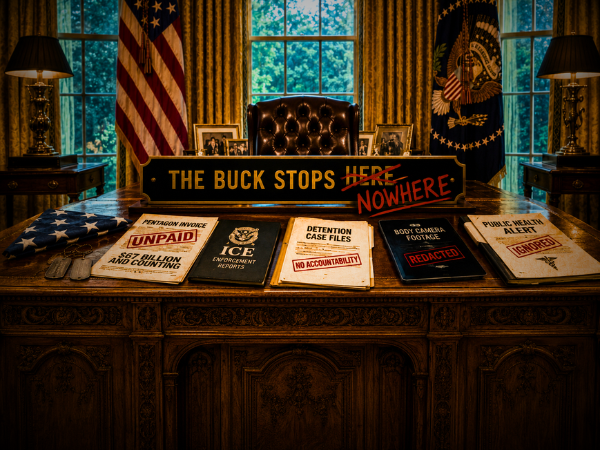
Under Trump, the buck stops nowhere.
Every consequence is transferred to someone else.
No one in power pays a personal price. No one admits fault. No one resigns. No one is prosecuted. No one is held accountable.
Instead, the public is told to move on. The policies continue. The machinery rolls forward.
This is how temporary abuses become permanent powers.
It is how republics become empires. It is how elected public servants become rulers who answer to no one. And it is how a government learns that it can inflict enormous harm without ever being required to pay a price.
Trump and Hegseth insist that anyone who kills an American will be hunted down and made to pay.
Yet who demands accountability when the decisions that cost American lives originate in the White House?
Who answers for the service members sent to die in an unconstitutional war launched without meaningful public debate or congressional authorization? Who answers for those who die during immigration raids, police encounters or government detention? Who answers when those in power enrich themselves while everyone else is left to bear the danger, instability and cost?
In the American Police State, the answer is almost always the same: Those in power are protected. Those without power bear the consequences.
The government operates above the law. Those who wield power become untouchable. Those who suffer are treated as disposable. Justice becomes whatever the government says it is.
And the machinery of government moves on without accountability.
“You had to live—did live, from habit that became instinct—in the assumption that every sound you made was overheard, and, except in darkness, every movement scrutinized.”—George Orwell, 1984
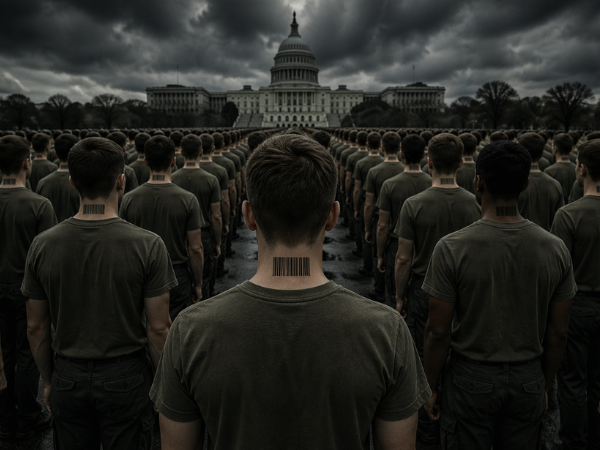
While Americans remain transfixed by the political circus—cheering for their preferred party, jeering at the opposition, obsessing over every manufactured outrage and waiting for the next spectacle—the Surveillance State continues its steady march forward.
It watches where you go, whom you meet, where you worship, what medical offices you visit, what political rallies you attend, what protests you join, what books you read, what websites you visit and what causes you support.
It watches through your phone, your car, your doorbell, your appliances, your purchases, your social media accounts and the cameras positioned along the roads you travel every day.
This is how freedom dies in the digital police state: not always through dramatic declarations of martial law or soldiers stationed on every street corner, but through the gradual construction of a technological dragnet—an electronic concentration camp—so pervasive that privacy becomes impossible and anonymity becomes suspicious.
Enter Flock Safety, a private surveillance technology company whose automated license plate readers have spread throughout thousands of American communities.
They document the time and location of every passing vehicle and record identifying characteristics such as its make, model, color, damage, roof racks, bumper stickers and other distinctive features. That information can then be placed in a searchable database and used to retrace a vehicle’s movements over time.
Yet the real power—and the real danger—of Flock does not come from the cameras alone.
It comes from artificial intelligence.
A camera can photograph a car. Flock’s AI-powered platform can identify and categorize a vehicle, compare an observation with stored records, generate alerts, identify connections and help police reconstruct where that vehicle has been.
AI is what transforms a photograph into the building blocks for a suspect society.
With AI, every driver becomes a data point. Every data point becomes a pattern. And every pattern becomes a suspicion.
This is how ordinary movements become potentially suspect and subject to government scrutiny. It allows law enforcement agencies to search not only for a complete license plate number but also for partial plates and physical descriptions such as vehicle color, make, model, damage, roof racks, bumper stickers and other identifying characteristics.
A police officer might ask the system to locate every red pickup truck with a ladder rack seen near a protest, every vehicle that repeatedly visited a particular address, or every car observed traveling between two locations.
The artificial intelligence does the sorting. The database supplies the history.
The government receives a list of potential suspects.
This is no longer surveillance conducted by individual officers following particular leads. It is surveillance conducted at machine speed, across entire populations, with algorithms deciding whose movements merit further scrutiny.
That is not targeted policing. That is mass collection.
The overwhelming majority of those scans do not involve stolen cars, wanted suspects, kidnappings or violent crimes. They document ordinary people carrying out the ordinary activities of daily life: driving to work, taking children to school, visiting friends, attending church, keeping medical appointments, participating in protests or simply going home.
Yet each of those innocent journeys becomes part of a searchable police database.
At 20 billion scans a month, Flock is not searching for particular suspects and then attempting to follow them. It is recording the movements of everyone so police can decide later whom they want to follow.
That is the digital equivalent of assigning a government agent to trail every driver in America—and preserving the agent’s notes in case the government someday finds them useful.
Yet mass collection is only the first stage of the AI surveillance state. The next is merging those billions of observations with everything else the government and its corporate partners know about us.
Flock is also part of a much larger shift toward AI-powered “data fusion,” in which license plate records are combined with facial recognition results, surveillance video, police reports, social media activity, commercially purchased information, gunshot-detection alerts and other government databases.
The danger is no longer merely that one system can track a car. It is the merger of previously separate streams of information into a single system capable of mapping a person’s movements, relationships, habits and associations.
These systems increasingly do more than provide officers with information to evaluate. They assign significance to associations, flag supposed threats and generate investigative leads—often through proprietary algorithms that neither the accused nor the public can examine.
Artificial intelligence does not eliminate human prejudice, institutional bias or bad information.
It industrializes them.
Feed a flawed system inaccurate data, biased arrest records or constitutionally suspect surveillance, and AI can reproduce those defects at a speed and scale no individual police officer could match.
Once the computer labels someone suspicious, moreover, officers may treat the algorithmic conclusion as objective fact.
Despite the extraordinary reach of this technology, Flock continues to portray its system as a limited, carefully controlled crime-fighting tool.
Flock insists that its cameras collect information about vehicles rather than people, that agencies control access to their own data, that searches are logged and that information is generally deleted after 30 days. Yet these assurances largely amount to distinctions without a difference.
Vehicles are extensions of the people who drive them.
Track a vehicle long enough, and you know where its owner sleeps, works, worships, shops, socializes, seeks medical treatment and participates in political activity.
You know when someone leaves home, when they return, whom they visit and how often.
You may not know the contents of their conversations, but you know enough to construct an intimate portrait of their life.
That is surveillance.
It does not become less invasive merely because the government has outsourced the cameras, databases and algorithms to a private corporation.
Nor does it cease to be surveillance because police claim that the information may someday be useful in solving a crime.
Indeed, that is the sleight of hand that has allowed the surveillance state to expand so rapidly.
The government no longer has to install every camera, maintain every database or directly collect every piece of information.
It merely encourages private companies, businesses, homeowners’ associations, schools and individual consumers to create an interconnected surveillance ecosystem—and then asks for access.
This public-private arrangement allows government agencies to acquire capabilities they might never receive public approval or sufficient funding to build on their own.
It also makes accountability almost impossible.
When abuses occur, local police blame the technology provider. The technology provider insists that local police control the data. Federal agencies claim they merely requested access. Local officials say they were unaware that information could be shared beyond their jurisdiction.
Everyone points elsewhere.
Meanwhile, the American people remain under observation.
Flock has become especially controversial because its network can transform what appears to be a collection of local cameras into something far more powerful: a searchable surveillance system that permits law enforcement agencies to look far beyond their own jurisdictions.
Flock says data sharing among agencies is optional and controlled by its customers. Yet the entire value of such a system lies in its interconnectedness.
A camera in one town is a traffic-monitoring device.
Thousands of cameras connected through searchable databases constitute a movement-tracking network.
The danger is not simply that police might search for a stolen car.
The danger is that the system permits government officials to begin with a location, a description or a fragment of information and work backward until someone emerges as a suspect.
That reverses the traditional order of constitutional policing.
Under the Fourth Amendment, police are supposed to develop individualized suspicion, establish probable cause and then apply for a warrant to search for evidence connected to a particular person or crime.
Mass surveillance systems begin by collecting information on everyone.
In the process, every innocent person is treated as a potential suspect whose movements must be recorded just in case the government someday decides they are relevant.
This is guilt by algorithm.
It is also the same constitutional inversion at the heart of geofence warrants, which allow police to demand information identifying every cellphone that happened to be near a particular location at a particular time.
The case involved a geofence warrant used to obtain Google location records for cellphones near the scene of a robbery. Rather than beginning with an identified suspect, police demanded information about devices that happened to be within a designated area during a particular period and then worked backward to identify their owners.
The Supreme Court held that police conduct a Fourth Amendment search when they obtain an individual’s cellphone location history from a technology company.
That conclusion matters.
It rejects the government’s increasingly convenient argument that intimate information loses constitutional protection merely because a private corporation collected, stored or analyzed it.
The Court did not rule on Flock cameras or automated license plate databases. Nor did it decide that every geofence demand is necessarily unconstitutional. The justices left it to the Fourth Circuit to determine whether the warrant satisfied the Fourth Amendment’s probable-cause and particularity requirements at each stage of the search.
Nevertheless, the constitutional principle at the heart of Chatrie extends far beyond cellphones.
The government should not be able to evade the Fourth Amendment by outsourcing mass surveillance to private technology companies.
It should not matter whether the location trail comes from Google, Flock, a cellphone provider, a data broker or an interconnected network of privately owned cameras.
A detailed record of a person’s movements does not become less revealing because it follows a vehicle rather than a phone. The government should not be permitted to accomplish through Flock what it could not constitutionally accomplish by assigning police officers to follow millions of Americans everywhere they drive.
Indeed, Flock may present an even more troubling inversion of constitutional policing.
Geofence searches generally begin with a particular crime, location and period. Flock continuously collects information on millions of vehicles before any crime has occurred and before any individual is suspected of wrongdoing.
Police can then reach backward into that stored history and reconstruct a person’s movements.
The surveillance comes first. Suspicion comes later.
A warrant, when one is sought at all, may arrive only after the government has already built the database it intends to search.
The technology is already embedded in thousands of communities.
The databases are already being populated.
The agencies are already connected.
And the companies profiting from this infrastructure will fight to preserve it.
Unfortunately, constitutional protections have rarely kept pace with the government’s appetite for surveillance.
The dangers are no longer theoretical.
Flock data has reportedly been used in investigations far removed from the serious violent crimes routinely invoked to justify these systems.
This is the inevitable trajectory of every surveillance technology. First, it is introduced as an emergency measure. Then it is justified as a crime-fighting tool. Then it is expanded to lesser crimes. Then it is used for administrative enforcement, political monitoring, immigration investigations and personal purposes.
Eventually, it becomes part of the background machinery of government—a permanent feature of daily life that no longer attracts attention because everyone has become accustomed to being watched.
Surveillance powers created to find kidnappers and violent criminals do not remain limited to kidnappers and violent criminals.
Databases built to locate stolen vehicles do not remain limited to stolen vehicles.
Government agencies cannot resist the temptation to use whatever power is available to them, especially when the use of that power is cheap, easy and largely hidden from the public.
The technology’s potential for error makes this even more dangerous.
License plate readers can misread plates, rely on inaccurate hot lists or associate an innocent vehicle with a crime. Once the system issues an alert, officers may treat the computer-generated result as fact.
The individual on the receiving end may be pulled over, surrounded by armed police, handcuffed, searched or detained before anyone discovers that the machine was wrong.
This is not justice. It is automated suspicion.
Flock is only one component of a surveillance ecosystem that includes doorbell cameras, facial recognition, drones, cellphone tracking, biometric databases and real-time crime centers.
A person may leave a home monitored by a smart doorbell, drive past a network of license plate readers, enter a business equipped with facial recognition, carry a phone broadcasting location data and return home along streets monitored by police cameras and private security systems.
At no point does the government need to physically follow that individual, because the infrastructure does it automatically.
Algorithms sort the information. Databases preserve it. Private companies monetize it. Government agencies search it.
All of this is taking place while the country remains locked in an endless partisan cage match.
Both parties have contributed to the Surveillance State. Both parties have expanded it. Both parties have exploited fear to convince the public that freedom must be sacrificed for safety.
The targets may change depending on who is in power, but the machinery remains.
Once the infrastructure exists, there is no guarantee that it will be used only against people you dislike or with whom you disagree politically.
That is the lesson Americans repeatedly refuse to learn.
A surveillance tool created by one administration will be inherited by the next. A database assembled for one purpose will inevitably be used for another. A system established to monitor “them” will eventually be turned against “us.”
Communities across the country are finally beginning to recognize the danger.
Some cities have terminated or declined to renew their Flock contracts. Others have paused deployments or demanded stronger restrictions on data sharing, retention and federal access.
This resistance is long overdue.
We cannot afford to become so distracted by the theater of politics that we fail to notice the architecture of tyranny being assembled around us.
The surveillance state does not care which party you support. It does not care whom you voted for.
It does not care whether you believe you have nothing to hide.
The cameras are watching. The databases are growing. The networks are connecting.
“Since when have we Americans been expected to bow submissively to authority and speak with awe and reverence to those who represent us? The constitutional theory is that we the people are the sovereigns, the state and federal officials only our agents. We who have the final word can speak softly or angrily. We can seek to challenge and annoy, as we need not stay docile and quiet.”—Justice William O. Douglas, dissenting in Colten v. Kentucky (1972)
President Trump has no problem criticizing, condemning, insulting, demonizing and threatening those who refuse to fall in line.
In Trump’s America, the president is free to call other nations bad actors, label his opponents dangerous, and treat disagreement as betrayal.
But dare to criticize Trump, his administration, ICE, the police state, the war machine, the surveillance state, or the government’s steady assault on the Constitution, and you may find yourself treated as the threat.
This is the hypocrisy of the moment: those in power claim an unlimited right to criticize everyone else, while increasingly denying the people the right to criticize them.
Criticize the government, question the police state, object to ICE raids, oppose war, challenge corruption, reject propaganda, refuse to salute the party line, or insist that public officials obey the Constitution, and you may find yourself accused of being anti-American, extremist, subversive, ungrateful, communist, terrorist-adjacent or worse.
This is how free speech dies: not all at once, but by redefining dissent as disloyalty.
Yet the First Amendment was not written to mandate flattery and applause for those in power. It was written to safeguard the right of the people to criticize, condemn, expose, challenge and resist government abuses without fear of being investigated, surveilled, threatened, prosecuted or treated like enemies of the state.
The American Revolution itself began as an act of criticism.
The Declaration of Independence was a bill of complaints against a government that had abused its power, violated the rights of the people, used the military to intimidate civilians, obstructed justice, imposed unjust burdens, and treated resistance as rebellion.
By today’s standards, the Founders would likely be labeled extremists, agitators, radicals, anti-government dissidents and threats to national security.
What was once rebellion against tyranny is now being recast as a warning sign of extremism.
That is the police state’s playbook for discrediting dissent: start with finger-pointing and name-calling, then turn criticism into subversion, dissent into danger, and those who demand accountability into enemies of the state.
We have seen this movie before. It was called McCarthyism.
Then, as now, the charge of “communism” was less about ideology than control: a smear used to discredit critics, frighten citizens, ruin reputations, trigger investigations, justify blacklists and make government power appear patriotic.
The accusation did not have to be true. It only had to be useful.
In the Trump administration’s telling, criticism of the country is evidence of ideological rot, radicalism or disloyalty. The message is unmistakable: love America or leave it; praise it or be punished; comply or be watched, surveilled and targeted.
That is not patriotism. That is tyranny dressed up in red, white and blue.
This campaign against dissent is not limited to protests, political speeches or social media posts. It extends to the past itself.
Consider the administration’s war on historical memory.
The Trump administration has now accused the Smithsonian’s National Museum of American History of pushing “extreme political activism.” In a 162-page report, the White House has attacked the museum for presenting aspects of American history that do not conform to the administration’s preferred ideology.
The Smithsonian’s offense, apparently, is that it has failed to sufficiently sanitize its depiction of American history by removing references to slavery, exploitation, Native displacement, civil rights struggles, labor unrest, police abuses, government lies, war crimes and the long, hard fight to make the words “We the People” mean something more than political decoration.
This is not about history. It is about whitewashing history.
A government that gets to dictate how the past is remembered will soon dictate how the present may be discussed. A government that insists museums must celebrate America rather than tell the truth about America is not defending patriotism. It is manufacturing propaganda.
History is not supposed to be a Hallmark card. It is supposed to be a warning.
That same demand for state-mandated devotion—the insistence that to love America one must flatter it, sanitize it and never demand better of it—was on display in the backlash to New York City Mayor Zohran Mamdani’s 250th anniversary remarks invoking the promises of the Declaration of Independence.
Whatever one thinks of Mamdani’s politics, the reaction to his speech was telling. Critics blasted the speech as ungrateful, divisive and hostile to American values, and Mamdani was denounced as anti-American for daring to suggest that America’s greatness lies not in pretending that its promises have already been fulfilled but in demanding that they be fulfilled for all.
Yet that is precisely what the Declaration of Independence was about.
The Declaration was a protest document. It did not flatter the king. It accused him. It did not praise the empire. It indicted it. It did not say, “Everything is fine.” It said the government had become destructive of the rights it existed to secure.
That is the American tradition.
Not government-approved history. Not obedience to presidents, police, generals, bureaucrats or political parties.
The American tradition is dissent. The American tradition is resistance to tyranny.
The American tradition is the right—and the duty—to criticize the government.
This is why the First Amendment stands first as a chain placed around the neck of government power: Freedom of speech. Freedom of the press. Freedom of religion. Freedom of assembly. The right to petition the government for a redress of grievances.
These are not separate freedoms. Together, they protect the ability of the people to speak, gather, organize, investigate, expose, protest and demand accountability from those who govern in their name.
Without the right to criticize the government, every other right becomes conditional.
Once the government is allowed to decide which criticism is patriotic and which criticism is dangerous, the Bill of Rights becomes a permission slip. Rights once guaranteed become privileges reserved for those who flatter power, obey orders and keep their grievances to themselves.
Once criticism is treated as extremism, constitutional rights become privileges reserved for the compliant.
This is why the government’s increasing tendency to equate dissent with danger should alarm every American, regardless of party.
We have already seen what this looks like.
Americans who criticize ICE online, write angry emails to government officials, document raids, protest enforcement actions, or speak out against official misconduct increasingly risk visits, warnings, subpoenas, surveillance or investigations by the government’s secret police.
The government does not need to jail everyone in order to silence a population. It only needs to make examples of a few.
A knock on the door. A warning from agents. A subpoena. A phone call from law enforcement. A file opened. A name entered into a database. A social media post flagged. A protest monitored. A journalist questioned. A nonprofit investigated. A student visa threatened. A donor list scrutinized. A museum audited. A professor disciplined. A mayor denounced as anti-American. A citizen taught to think twice before speaking again.
This is how a free people are trained to censor themselves.
Let us be clear: violence and true threats can and should be investigated. No one has a constitutional right to assault, threaten, stalk, bomb, kill or terrorize.
But criticism is not violence. Anger is not terrorism. Dissent is not extremism. Opposition is not treason. Petitioning the government for redress of grievances is not a crime. It is the essence of citizenship.
Yet every administration, sooner or later, discovers the convenience of labeling its critics as threats.
John Adams used the Sedition Act to punish critics of the federal government. Woodrow Wilson used the Espionage and Sedition Acts to prosecute antiwar speech. Richard Nixon kept enemies lists. George W. Bush gave us the Patriot Act, warrantless surveillance, watchlists and the language of “with us or against us.” Barack Obama targeted whistleblowers. Joe Biden’s administration leaned on agencies and platforms in the name of combatting misinformation and domestic extremism. Donald Trump has taken all of that machinery and openly aimed it at political enemies, protesters, immigrants, journalists, universities, museums, law firms and anyone else who refuses to bow.
Do not make the mistake of thinking this is merely a Trump problem.
Trump is not the disease. He is the symptom.
The disease is power.
The disease is a government that believes it may define truth, patriotism, extremism, history, loyalty and acceptable opinion. The disease is a police state that has learned to speak in the language of safety, order, border security, anti-terrorism, anti-communism, anti-radicalism, public health, national unity and American greatness.
The disease is the dangerous idea that government exists to be obeyed rather than restrained.
The Founders knew better.
They did not trust government. They bound it down.
They did not assume that rulers would be virtuous. They divided power, checked power, limited power and gave the people the tools to expose and resist power.
They understood that the greatest threat to liberty would not come from citizens criticizing the government. It would come from government officials who believed themselves entitled to silence criticism.
That is why the right to criticize government cannot be treated as a partisan indulgence.
No matter which party holds power, the people must be free to criticize the government.
When Republicans are in power, Democrats must be free to criticize the government. When Democrats are in power, Republicans must be free to criticize the government.
When police, ICE, the military, the courts, Congress or the president abuse their authority, citizens must be free to say so—loudly, publicly and without fear of being branded enemies of the state.
This is not incitement. This is accountability.
A government that cannot tolerate criticism does not deserve power. A president who treats dissent as disloyalty has betrayed his oath of office. A nation that punishes its truth-tellers has lost sight of its principles.
And a people who self-censor because they are afraid to criticize their government are no longer free.
This is the great danger of the moment.
We are being told that to love America, we must stop seeing what has been done in America’s name. We must stop talking about the bodies, the prisons, the raids, the wars, the surveillance, the corruption, the cages, the lies, the poverty, the brutality, the stolen land, the stolen labor, the broken treaties, the broken families, the broken promises and the broken Constitution.
We are being told that patriotism requires amnesia.
That is a lie.
Real patriotism is not worship of government. Real patriotism is not loyalty to a president. Real patriotism is not blind obedience to police. Real patriotism is not a flag big enough to cover up injustice.
Real patriotism is the willingness to tell the truth about your country because you believe it can and must be better.
Those who criticize America are often the only ones still taking America seriously.
The abolitionists were called agitators. The suffragists were called radicals. The labor organizers were called subversives. The civil rights marchers were called outside agitators and communists. The antiwar protesters were called traitors. The whistleblowers were called criminals. The journalists were called enemies of the people. The immigrants demanding dignity are called invaders. The citizens filming police are called threats. The protesters opposing ICE are called extremists. The historians telling the truth are called activists.
The pattern never changes. Power always has a vocabulary for discrediting those who challenge it. Yet history has repeatedly vindicated the critics.
America did not become freer because citizens kept quiet. America became freer because citizens made themselves impossible to ignore. They marched. They wrote. They spoke. They published. They exposed. They resisted. They refused to comply with unjust laws. They demanded amendments. They challenged police. They sued officials. They filled jails. They confronted presidents. They forced the country to look in the mirror.
That is not anti-American. That is how America survives.
The irony is that the loudest defenders of “American greatness” are often the most eager to criminalize the very conduct that made America possible.
They celebrate 1776 while condemning the spirit of 1776. They praise the Founders while fearing the people. They quote the Declaration while attacking those who petition for redress of grievances. They wrap themselves in the flag while trampling the freedoms for which the flag is supposed to stand. They call themselves patriots while demanding servility.
They insist that America is exceptional while treating the Constitution as optional.
They want citizens who salute, not citizens who think. They want history without victims, rights without resistance, liberty without dissent, and patriotism without conscience.
That is not freedom. That is authoritarianism with fireworks.
In such a climate, silence is surrender.
When the government claims the power to decide what history may be taught, what speech may be tolerated, what criticism may be investigated, what protest may be monitored, what viewpoint may be flagged, and what truths may be spoken, the people have a duty to push back.
We must insist that the First Amendment protects the speech government hates most. We must insist that criticizing ICE is not a crime. We must insist that criticizing the president is not treason. We must insist that criticizing police is not extremism. We must insist that criticizing America’s failures is not anti-American. We must insist that history belongs to the people, not to politicians. We must insist that no president, no agency, no party and no bureaucrat gets to decide what patriotism requires.
We must insist that the Constitution means what it says.
After all, the government works for us—not the other way around. The moment Americans forget that, the experiment in self-government is over.
So criticize the government.
Criticize it loudly. Criticize it relentlessly.
Criticize it when it spies, lies, censors, raids, detains, prosecutes, propagandizes, militarizes, profiteers and abuses.
Criticize it when it rewrites history, calls truth anti-American, mistakes obedience for patriotism, and forgets that “We the People” are the masters and the government is the servant.
We pay for the lawsuits, the settlements, the cover-ups, the damage control, the reconstruction, the overreach, the incompetence and the corruption.
And when government officials are finally called to account for their misconduct, we pay for that, too.
That is the dirty little secret of government accountability in America: even when the government loses, the government does not really pay. “We the people” do.
This is not a problem invented by Donald Trump.
For decades, politicians, police officers, prosecutors, prison officials, federal agents and bureaucrats of both parties have violated rights, exceeded their authority, misused public power and left taxpayers to pick up the tab.
The wrongdoers rarely pay personally. They get to keep their pensions, promotions, pardons, security details and speaking fees. The government agencies involved in misconduct rarely suffer lasting consequences. The victims get a check drawn on taxpayer funds.
And the tax-paying populace gets to pay for the settlements, the legal fees, the court costs, the reconstruction costs and the long-term damage to trust in government.
The message is coming across loud and clear: the government can violate our rights in every way possible—using resources that we are forced to provide—and then it can turn right around and make us pay to clean up its many messes and right its many wrongs.
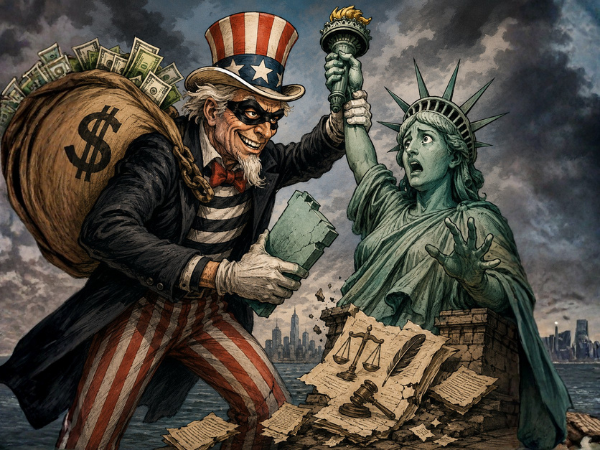
This is the Art of the Steal.
Trump, having taken to government corruption like a duck to water, has made ripping off the taxpayers the cornerstone of his governing philosophy.
During his second term in office, Trump has established a track record of forcing the public to subsidize the consequences of his own recklessness: rewarding allies, funding unconstitutional crackdowns, rebuilding what he tears down, bankrolling vanity projects, and attempting to buy his way out of crises he helped create.
Start with Iran.
Trump’s war with Iran is a case study in the Art of the Doublecross.
Candidate Trump sold himself as the antidote to endless war. He promised strength without entanglement, peace through power, no new wars, no more nation-building, no more wasting American lives and treasure on conflicts that do not serve the American people.
Now, after dragging the country into a preemptive, unprovoked war with Iran that Congress never authorized—a war that has rattled global markets, driven up energy prices, depleted military resources, risked regional escalation, and inflicted real economic pain on Americans already struggling to afford groceries, gas, insurance and debt payments—Trump needs help fixing the crisis he helped create.
Whatever the final terms of any so-called peace arrangement—assuming such a thing is actually forthcoming—taxpayers will bear the cost. Trump has announced, teased and promised breakthroughs before, only for the details to shift, the terms to unravel, or the supposed deal to become another bargaining chip in an endless cycle of threats, deadlines and reversals.
Rest assured, the price of Trump’s war will not be limited to missiles fired and ships deployed. It will include lives lost, military resources depleted, global markets rattled, energy prices spiked, alliances strained, enemies emboldened, and diplomatic concessions made to end a conflict that diplomacy might have prevented in the first place.
Even if U.S. taxpayers do not directly write the check for a reported $300 billion reconstruction framework, the absurdity remains: Trump starts the war, others negotiate the cleanup, and the American people are left paying the political, economic and constitutional costs.
They are also paying through the dangerous precedent that empowers an imperial president to start a war based on instinct, impulse or political convenience, without constitutional accountability.
That is no small thing.
The Constitution gives Congress, not the president, the power to declare war. That safeguard was not a procedural technicality. It was meant to prevent exactly this kind of unilateral adventurism: one man gambling with the lives, liberties and livelihoods of millions, then sending the invoice to the people.
The public pays while the politicians posture.
That is how government turns recklessness into public debt: first by provoking the crisis, then by charging the people for the cleanup, then by pretending the cleanup is a triumph.
Yet not every government bill arrives in the mail.
Some arrive at the gas pump, the grocery store, the insurance premium, the interest rate, the shrinking paycheck, the empty Treasury, and the next generation’s debt.
Others arrive later, in the form of lawsuits, settlements, damages, broken families, shattered communities and rights that must be clawed back in and out of court after the damage has already been done.
Iran is only the most explosive example.
We are seeing this destruction play out on almost every front: wars, raids, tariffs, deportations, political payouts, lawsuits, pardons, institutional wreckage and vanity projects.
Every unconstitutional executive order, retaliatory investigation, purge, firing, freeze, funding cutoff, loyalty test and administrative abuse produces another round of emergency litigation, government lawyers, court costs, injunctions, appeals and attorney fees.
Trump governs by breaking things. Taxpayers pay for the repair.
But some things cannot be repaired with money alone.
Who will pay to rebuild what Trump and the architects of the police state have destroyed of our constitutional republic?
As always, that burden will fall on the American people.
Trust, once shattered, is not so easily restored.
Institutions, once vandalized, do not repair themselves.
Constitutional limits, once treated as optional, become harder to restore with every violation.
And then there are the vanity projects, where the symbolism becomes almost too obvious to miss.
Trump’s so-called “beautification” projects—gaudy, expensive and self-serving—speak volumes about his disastrous approach to governing.
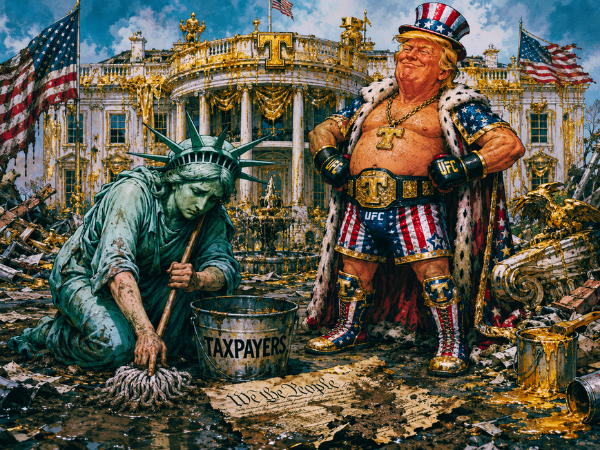
The Lincoln Memorial Reflecting Pool, a public landmark that has served as the backdrop for historic moments from Marian Anderson’s 1939 concert to Martin Luther King Jr.’s “I Have a Dream” speech, has become a veritable swamp of slime after Trump, without meaningful oversight and at a grossly marked-up expense, decided by fiat to “fix” it and use it and the Lincoln Memorial as the backdrop for a UFC fight weigh-in.
The Reflecting Pool fiasco is the Trump presidency in miniature: gaudy, expensive, performative and already covered in algae.
That warning was not about wallpaper, furniture or ceremonial rooms.
It was about stewardship. It was about vigilance. It was about recognizing that the house belongs not to the occupant, but to the people whose dreams, sacrifices and constitutional inheritance it is supposed to shelter.
Trump’s transformation of the White House is a visual reminder of what he has done to the presidency itself: taken what belongs to the people, stripped it for parts, gilded what remained, and presented the wreckage as grandeur.
It is embarrassing. It is grotesque. It is a national humiliation.
This is what the American experiment in self-government has been reduced to: a constitutional republic dressed up like a casino, a people’s house converted into a stage set, a presidency refashioned as a brand extension, and taxpayers forced to underwrite the spectacle.
The founders never assumed the experiment would survive on autopilot.
They knew self-government was fragile. They knew republics decay when citizens become spectators, when public servants become rulers, when law becomes optional for the powerful, and when the people are made to finance their own subjugation.
That is why the spectacle matters.
The gilding of the people’s house is not just a question of bad taste or bloated expense. It is constitutional graffiti: a ruler’s signature scrawled across the people’s house.
It is a warning sign: a government that has forgotten the difference between public trust and private entitlement, between stewardship and ownership, between serving the people and ruling over them.
There is something obscene about gilding the people’s house while the people are being asked to pay for wars they did not approve, tariffs they were told foreigners would pay, raids carried out in their name, deportation schemes that endanger human lives, unconstitutional orders struck down by the courts, and settlements for abuses committed by government agents.
That is the real cost of cleaning up Trump’s messes.
It is not merely the $1.776 billion slush fund, the tariff refunds, the deportation flights, the ICE raids, the Reflecting Pool, the East Wing, the Iran war, the courtroom defenses, the settlements or the gilded pageantry.
It is the conversion of citizenship into servitude.
It is the expectation that the people will pay for their own surveillance, their own intimidation, their own impoverishment, their own silencing, their own manipulation, and their own loss of power.
It is taxation for domination.
It is government by mess, followed by government by invoice.
It is the rewriting of the American Dream from a dream of opportunity for all to a dream of entitlement for a select, privileged few.
The American Revolution was fought, in part, against a government that forced people to finance their own subjugation.
That warning still applies.
When Americans are made to pay for undeclared wars, unlawful tariffs, militarized raids, political payouts, constitutional violations, palace renovations and the settlements that follow government abuse, they are not merely being overcharged.
One way or another, the American taxpayers always get screwed by politicians eager to spend our hard-earned dollars on programs and projects that do little to improve our lives, safeguard our freedoms, or secure our future.
From the proposed White House ballroom and its taxpayer-backed security upgrades, to the high-dollar UFC spectacle planned for the White House lawn, to pardons that function less like mercy than loyalty rewards, to government access increasingly conditioned on political obedience, Trump has turned the presidency into a private rewards program for himself, his donors, his allies and his enforcers.
Every new abuse is wrapped in the language of patriotism, security or justice. Every bill lands, sooner or later, on the backs of the American people.
Thus, rather than draining the swamp, Trump has shown himself to be the veritable swamp monster, mired in the muck and determined to keep it that way.
Trump’s latest grift? A taxpayer-funded slush fund, dressed up as justice, purportedly to compensate those who claim they were targeted by the “weaponization” of the Biden Justice Department and Democrats.
As part of the same settlement, the government also reportedly agreed to bar the IRS from auditing Trump, his family, the Trump Organization and related entities over tax filings and claims predating the agreement—a breathtaking act of self-protection disguised as legal closure that helps shield the president and his empire from the very kind of government scrutiny ordinary Americans are expected to endure without complaint.
Taken together, the payout fund and the audit shield expose the real purpose of this so-called anti-weaponization crusade: not to end weaponized government, but to decide who gets protected by it, who gets paid by it, and who gets crushed by it
Read between the lines of the deliberately vague information provided about this “Anti-Weaponization Fund,” which will be seeded with $1.776 billion in taxpayer funds, and it starts to look suspiciously like a fund to reimburse those convicted, investigated or politically inconvenienced for crossing legal lines in service to Trump’s agenda.
If it looks like corruption—and it smells like corruption—there’s a good chance it’s corruption.
At best, this is an outrageous misuse of taxpayer money. At worst, it is yet another perverted form of Trump’s presidential pardons, which have overwhelmingly benefited political loyalists, donors, grifters, extremists, and individuals either convicted of crimes in pursuit of Trump’s ambitions or useful to advancing those ambitions in the future—or both.
The message is unmistakable: commit crimes that benefit those in power, and those in power will absolve you, reimburse you, excuse you, or reward you.
These are not miscarriages of justice being corrected. They are protection payments, signals to future operatives: do what we need you to do, and we will take care of you.
But who will compensate “we the people” for the damage done when the government weaponizes its powers against us?
Who will compensate the people surveilled without warrants, raided without cause, censored for their views, bankrupted by fines and fees, brutalized by militarized police, jailed without due process, dragged through the courts, disappeared into detention centers, or treated as enemies of the state for exercising their constitutional rights?
Who will compensate the victims of a police state that has been weaponized by Republicans and Democrats alike?
That is the real question.
The Trump administration claims this fund is about redressing government weaponization.
Yet at the very same time, it is weaponizing the government against the citizenry: against protesters, immigrants, law firms, judges, journalists, universities, critics, whistleblowers, and anyone else who stands in the way of executive power.
This is what it means to weaponize the government.
When the government turns its power against its own people—through surveillance, retaliation, censorship, and intimidation—it ceases to serve the public and instead becomes a weapon of oppression.
Time and again, presidents and power-hungry politicians have stretched—or outright shattered—the limits of their authority, weaponizing government power through unjust laws, surveillance, censorship, detention, intimidation and suppression.
Each power grab is another way of turning government into a weapon.
John Adams used the Alien and Sedition Acts to prosecute journalists and political opponents.
Abraham Lincoln suspended habeas corpus, allowing the military to detain individuals without trial and suppressing Confederate sympathizers and political dissenters.
Under Woodrow Wilson, the Espionage and Sedition Acts were used to crack down on anti-war activists, socialists, and labor organizers, including Eugene V. Debs, who spoke out against World War I.
Spanning numerous presidential administrations, from FDR to Nixon, the FBI’s covert intelligence program COINTELPRO was used to infiltrate, discredit and disrupt civil rights leaders, anti-war activists, and other political dissidents.
In a bid to fight so-called disinformation, Biden pressured social media companies to censor and suppress individuals expressing views perceived as conspiratorial or extremist, especially as they related to COVID-19.
Indeed, Ken Hughes, an investigative journalist who spent two decades listening to Richard Nixon’s Secret White House Tapes, has concluded that Nixon’s abuses of presidential power—which included weaponizing the government to sabotage Vietnam peace talks, manipulate the timing of withdrawal from Vietnam, and spring former Teamsters president Jimmy Hoffa from prison in return for political support—pale beside Trump’s abuses.
The danger is not Trump alone. The danger is Trump backed by enablers-to-abuse: the many minions within his administration and beyond who are eager to carry out unlawful orders, defy the courts, ignore Congress, trample rights, and butcher the Constitution in the name of putting America first.
If this keeps up, America—once held up as a bastion of freedom and economic opportunity—will be the last place anyone thinks of when they hear the words freedom, justice and equality.
Don’t be so carried away by fear-inducing tales of rapists, foreign invaders, corruption, crime waves and political persecution that you let the government get away with murder: the painful execution of our rights.
That way lies tyranny.
You can see the pattern forming already.
When protesters are snatched up, arrested, prosecuted or surveilled for challenging government policy, that is government weaponized against dissent.
When immigrants are rounded up, chained, deported or detained without meaningful due process—without being properly identified, charged, heard, or allowed to challenge the government’s claims—that is government weaponized against due process.
When law firms are punished for the clients they represent, barred from federal buildings, stripped of security clearances, threatened with the loss of contracts, or pressured into providing hundreds of millions of dollars in legal services aligned with the administration’s priorities, that is government weaponized against the right to counsel.
When judges are derided, defied or threatened for ruling against the president’s agenda, that is government weaponized against the separation of powers.
When universities are threatened with funding cuts, investigations and ideological purges for failing to toe the government’s line, that is government weaponized against academic freedom and independent thought.
When journalists and critics are branded enemies, liars, radicals, criminals or traitors for questioning official narratives, that is government weaponized against the First Amendment.
When government websites, archives, agencies and public records are rewritten, scrubbed or politicized in order to reshape history, control memory, and enforce ideological obedience, that is government weaponized against truth.
When the president threatens other nations militarily, talks openly about seizing foreign lands, stirs up international tensions, rattles the war drums, and then claims wartime powers at home, that is government weaponized against peace, liberty and constitutional restraint.
The only real protection we have against tyranny is the rule of law, provided that the people and the system of government still hold the rule of law as inviolable.
That is our real power: the extent to which we hold fast to the Constitution and demand that the government and its agents do so, as well.
The moment that we relent in that commitment—the moment that we look the other way and let first a few encroachments slide, then ever more and more—is the moment the Constitution loses its power to protect us against tyranny.
That is what is unfolding right now.
This is the devil’s bargain that we are being asked to enter into with Trump: empty promises and a one-way street to a dictatorship in exchange for our freedoms.
When any politician suggests that you relinquish your freedoms—of speech, assembly, due process, association, etc.—in exchange for promises of greater security, you’d better beware. Your freedoms will be next on the chopping block.
When any politician persuades you to look the other way while innocent individuals are rounded up alongside suspected criminals just because they look a certain way, talk a certain way, worship a certain way, protest a certain way, or belong to a particular demographic, you’d better beware. Your right to due process will be next.
When any politician comes up with a vast array of reasons why he doesn’t need to obey court rulings—because they were issued verbally, because his power trumps that of the courts, because the courts are biased, because national security demands obedience, because the law ends at the border—you’d better beware. This shifty reasoning for breaking the law could be used against you next.
There can be no doubt about the nature of what is taking place right now.
This is government weaponized into war.
President Trump’s justification for defying the courts and doing whatever he wants in pursuit of his political agenda (arresting protesters, carrying out mass arrests and deportations, muzzling critics, seizing funds, dismantling agencies, usurping congressional powers) is that “this is war.”
Here’s the thing, though: Trump may be using the language of war to bypass the Constitution at every turn, but the only war being waged is a war against the Constitution, the rule of law and the American people.
In ruling after ruling, the courts, which have the judicial power to rein in overreach and misconduct, have pushed back against the Trump administration’s steady dismantling of constitutional limits. And still Trump is unilaterally hacking away at the very foundations of our system of government.
If the president refuses to be held accountable, insists his power is supreme, abuses the power of his office to wreak havoc and revenge, reduces our republic to rubble, tramples the Constitution, and disregards the rule of law, he is aligning himself with every despot, dictator and tyrant to have walked the earth.
We’ve been here before. We know how this story ends.
It takes time and effort and a willingness on the part of “we the people” to look beyond our differences and stand united in opposition to oppression, but when we do that, freedom prevails in the end.
What’s just as important, however, is what came before that: the small steps of rebellion, resistance and outrage that said, “enough is enough.”
What we are now experiencing is not simply a partisan power struggle. It is the weaponization of the machinery of government for compliance and control.
The objective: obedience.
The strategy: destabilize the economy, polarize the populace, escalate racial and political tensions, intensify the use of violence, and then, when all hell breaks loose, clamp down on the nation for the good of the people and the security of the nation.
The outcome for this particular conflict is already foregone if we refuse to resist: the Deep State wins.
The Deep State wins by ensuring that we are censored, silenced, muzzled, gagged, zoned out, caged in and shut down.
It wins by monitoring our speech and activities for any sign of “extremist” activity.
It wins by ensuring that we are estranged from each other and kept at a distance from those who are supposed to represent us.
It wins by saddling us with taxation without representation and a government without the consent of the governed.
It wins by terminating the Constitution—or rewriting it until it no longer restrains those in power.
So where does that leave us?
“We” may have contributed to our downfall through our inaction and gullibility, but we are also the only hope for a free future.
After all, the Constitution begins with those three beautiful words, “We the people.”
Those three words were intended as a reminder to future generations that there is no government without us: our sheer numbers, our muscle, our economy, our physical presence in this land.
When we forget that—when we allow the “me” of a self-absorbed, narcissistic, politically polarizing culture to override our civic duties as citizens to collectively stand up to tyranny and make the government play by the rules of the Constitution—that is when tyranny rises and freedom falls.
Remember, there is power in numbers.
Not the kinds of numbers that Trump likes to spout about landslide victories and electoral mandates, but the most powerful numbers of all: the sheer, overwhelming mass of humanity that is “we the people” of these United States of America.
If there is any means left to us for thwarting the government in its relentless march towards outright dictatorship, it rests with us.
Ultimately, that’s what the Tenth Amendment to the Constitution is all about: it affirms that “we the people” have all the power, and what powers we do not explicitly give to the federal government or the states, we retain.
We may appoint government representatives to act in our stead, but we never relinquish that power altogether.
That’s where Trump and his Deep State handlers get it wrong. Speaking through him and his administration, they claim that this dismantling of the federal government is a bid to return power to local communities and state governments, but it’s not their government to dismantle, nor is it their power to return.
We are the government.
We are the power.
And it’s time “we the people” reminded the government and its henchmen of that important fact.
The power still lies with us.
We must resist every attempt to erode our freedoms, demand accountability, and uphold the Constitution before it’s too late.
It’s time to invalidate governmental laws, tactics and policies that are illegitimate, egregious or blatantly unconstitutional.
Nullify everything the government does that flies in the face of the Constitution.
Flood your representatives’ phone lines, inboxes and townhall meetings with your discontent.
Protest everything that tramples on the Constitution.
Stand up for your own rights, of course, but more importantly, stand up for the rights of those with whom you might disagree.
Defend freedom at all costs. Defend justice at all costs. Make no exceptions based on race, religion, creed, politics, immigration status, sexual orientation, etc.
Don’t play semantics. Don’t justify. Don’t politicize it.
If it carries even a whiff of tyranny, oppose it.
Demand that your representatives in government cut you a better deal, one that abides by the Constitution and doesn’t just attempt to sidestep it. That’s their job: make them do it.
And don’t let them distract you with slush funds, payouts, pardons and political theater disguised as justice.
If the government is going to compensate anyone for being victimized by weaponized power, then start with “we the people.”
Start with the Americans whose rights have been trampled by SWAT teams, surveillance dragnets, censorship regimes, secret watchlists, police brutality, asset forfeiture schemes, no-knock raids, indefinite detentions, politically motivated prosecutions, and every other tactic by which the police state has turned the Constitution into collateral damage.
Start with the people forced to pay for their own oppression.
Until then, this so-called Anti-Weaponization Fund is not justice.
It is hush money for the powerful, paid for by the powerless.
It is the weaponized government rewarding its own while leaving the rest of us to foot the bill.
“Disinformation does not mean false information. It means misleading information—misplaced, irrelevant, fragmented or superficial information—information that creates the illusion of knowing something, but which in fact leads one away from knowing.”—Neil Postman, Amusing Ourselves to Death
Call it what it is: a heist.
The corruption, cronyism, and self-dealing that now define the American government—under Donald Trump in particular—amount to a slow-motion stick-up carried out in broad daylight.
But here’s the trick: it’s a heist hidden behind spectacle. The Trump administration is flooding the stage with noise so “we the people” don’t notice what’s happening behind the curtain.
We’re being manipulated into watching the wrong thing.
The distractions are part of the plan to rob us blind.
You don’t have to look far to see how the con works. Nowhere is the hustle more obvious than in how the presidency itself is being used.
For the Trump family, the presidency isn’t public service. It’s an all-access pass to wealth, power, and privilege—an ongoing exercise in how to squeeze maximum personal gain out of public office.
Not to lower your grocery bill. Not to fix your healthcare. Not for infrastructure that serves the public.
For a ballroom.
A taxpayer-funded space where donors, insiders, and elites can gather and trade access—while the average American is left outside looking in.
The grift has become so obvious, Americans are finally taking notice.
Poll after poll shows the same thing: people are fed up.
Not just with the economy but with a president who seems more focused on himself, his image, and his vanity projects than on the people he’s supposed to serve.
A Washington Post poll puts it clearly: disapproval with Trump’s job performance is rising, with 62% unhappy about his job as president, 76% dissatisfied with how he’s dealing with the cost of living, 72% unhappy about his handling of inflation, 65% against his handling of the economy, and 66% opposed to the war with Iran.
They’re right to be unhappy.
While Americans struggle to make rent, pay for groceries, and stay afloat, the government is bankrolling ballrooms.
But here’s what most Americans are missing: the ballroom isn’t just a vanity project. It’s a distraction.
So are his plans to redo the East Potomac Golf Course.
So are his endless, bombastic, outrage-driven, manic, headline-making Truth Social posts.
Trump is good at pushing people’s buttons. He knows exactly what will outrage, distract, and drag people into one more pointless argument.
The bigger and louder, the better. That’s the show.
And while we’re watching Trump’s bread-and-circus antics, something else is happening.
The real damage to our republic is being buried—delayed, redacted, denied.
This shell game keeps our attention fixed on Trump’s costly antics while his partners-in-crime use the diversion to lock down the country and strip us of what’s rightfully ours.
It’s not just one elaborate ruse, either, but a series of cover-ups and obfuscations meant to keep us from looking too closely or asking too many questions about what’s really going on.
What began as a scramble to redirect public attention—from questions about Epstein to war, White House spectacles, immigration crackdowns, and culture-war theater—has become an ever-widening web of manufactured distractions and diversions.
Satellite imagery has been restricted. Access has been limited. Reporters are forced to rely on foreign aerial images and secondhand accounts just to piece together what’s happening.
And the lack of transparency doesn’t stop there.
Reports suggest the Pentagon has downplayed casualty figures of U.S. troops killed or wounded during the Iran war.
Oversight of DHS, ICE, and private contractors is being curtailed.
And interest payments on that $31 trillion national debt are consuming one out of every seven dollars spent by the government. As Robert Reich, a former Secretary of Labor, warns, “That’s money we don’t spend on education, healthcare, roads and bridges, social safety nets, or (if we actually needed more spending on it) national defense.”
We don’t need an economist to spell it out for us, but there are ample warnings about the toll Trump’s costly policies are taking on the economy.
While both political parties share responsibility for decades of fiscal mismanagement, the Trump administration has accelerated the crisis through a toxic combination of reckless spending, tax giveaways, and costly, unauthorized wars.
Promises to “drain the swamp,” balance the budget, and restore fiscal discipline have given way to ballooning deficits and trillion-dollar spending packages dressed up as economic revival.
Even the administration’s so-called cost-cutting measures fail to hold up under closer scrutiny.
Despite the propaganda pushed by DOGE and its supporters, nothing about the Trump administration has added up to savings for the American people.
Instead, Americans are seeing cuts to healthcare, education, housing assistance, and programs that provide economic stability.
At the very moment Americans are struggling to make ends meet, the Trump administration is spending big—at taxpayer expense—on projects that appeal to Trump’s ego, stoke his vanity, consolidate his power, reward his allies, or entrench the police state’s machinery of control.
Nero fiddled while Rome burned.
Trump is playing golf while America burns—and he keeps striking the match.
While “we the people” are paying more for everything, Trump is getting richer off the presidency—at taxpayer expense.
Much richer.
Billions added to his fortune—while in office. His family’s wealth has exploded.
Trump’s net worth has surged to an estimated $6.5 billion. According to Forbes, Trump added $1.4 billion in a single year by leveraging the presidency for profit—fueled by cryptocurrency ventures, revived licensing deals, favorable legal outcomes, and a rush of foreign business interests seeking proximity to power.
Trump’s family is also cashing in, doubling their net worth since the 2024 election to an estimated $10 billion.
We the people. Especially those of us that do not belong to the political and corporate elite.
For most Americans, life is getting harder.
Gas prices are up. Groceries are up. Healthcare costs are up.
Paychecks? Not keeping up.
And what is the government doing? Not easing the burden. Not restoring balance.
And Trump?
He jets off to Mar-a-Lago at taxpayer expense. He golfs while dragging a full security detail along. He’s turning the White House—and by extension, much of the nation’s capital—into his personal domain, redecorating according to his personal tastes, with little concern for the wishes of the American people.
He lives like a king, while we pay for his excesses, one way or another.
He’s slashing government spending for programs that educate, protect, and support Americans, while building a $1.5 trillion war machine and boosting all aspects of the police state that treats us like suspects—locking us down and locking us up.
He’s building monuments to his own ego: a $400 million ballroom—now potentially a $1 billion taxpayer-funded monument to access and influence if Senate Republicans get their way; professional, taxpayer-funded golf courses that take the place of public parks; a new Trump-class “Golden Fleet” of battleships, costing $13 billion each.
He’s pushing for airports and train stations and other infrastructure to bear his name, then tacking on dubious licensing agreements for the so-called privilege.
At the same time, medical research is gutted. Job training gets cut. Environmental protections get axed. Disaster relief gets hollowed out. Welfare for the most vulnerable gets short-changed.
This isn’t just mismanagement. This isn’t just bad policy.
This is a system that takes from us and gives to the corporate and political oligarchic elite.
We pay more. “They” gain more.
Wars only make it worse.
Every missile. Every deployment. Every “operation.”
Paid for by “we the people.” Not just in taxes—but in higher prices, higher debt, and fewer services.
Pete Hegseth has been boasting that thanks to Trump’s $1.5 trillion defense budget, the Department of War is running war like a business.
The truth is, they’re turning war into big business and cashing in.
In one of the most glaring examples of this, the Associated Press reports that Trump’s sons have, in his second term, expanded their business interests beyond hotels and golf courses to a broad range of investments that include cryptocurrency ventures, prediction markets, federal contractors making rocket parts, and rare earth magnets.
Conveniently timed to coincide with Trump’s war on Iran, his sons have also gotten into the drone manufacturing business, selling to countries in the Middle East eager to curry favor with the Trump administration.
As Richard Painter, a former chief White House ethics lawyer under President George W. Bush, observed, “These countries are under enormous pressure to buy from the sons of the president so he will do what they want. This is going to be the first family of a president to make a lot of money off war—a war he didn’t get the consent of Congress for.”
This is how you turn government into a profit machine.
Once again, we find ourselves confronted by the age-old debate over our national priorities and the choice between investing heavily in guns or butter—military might or domestic needs.
Once again, we find ourselves watching from the sidelines as big-talking politicians justify stealing from “we the people” in order to pad the pockets of the military industrial complex.
As The Guardian notes, to help pay for his expanded military budget, “Trump is seeking a 10% cut in discretionary domestic spending, chopping such popular programs as medical research, job training, home heating assistance, environmental protection and disaster relief after hurricanes.”
This is exactly the moral theft President Dwight D. Eisenhower warned about: stealing from social and domestic needs in order to build up the military-industrial complex.
In Trump’s case, he wants guns and caviar: military might for the empire, wealth for himself, and less for America’s most vulnerable.
“We’re fighting wars,” Trump announced at an Easter luncheon. “It’s not possible for us to take care of daycare, Medicaid, Medicare … They can do it on a state basis. You can’t do it on a federal. We have to take care of one thing: military protection.”
Unfortunately, Trump’s version of military protection is a costly display of macho posturing.
Marjorie Taylor Greene was right to course-correct. “I don’t have Trump Derangement Syndrome,” she said. “I have Trump Disappointment Syndrome.”
Trump Disappointment Syndrome is spreading.
This is, unfortunately, how the game works: less for us, more for them—paid for by “we the people.”
Yet just as important as the math involved in bleeding us dry is the conspiracy of distraction that keeps us in the dark about the theft in our midst.
That’s where the distractions come in: the ballroom, the golf course, the spectacles on the White House lawn.
Give the public something to watch. Something to argue about. Something impossible to ignore.
They want our outrage, not our scrutiny.
Keep the spotlight bright, so no one notices what’s happening in the shadows.
While the public watches the spectacle, the money is moving.
The spectacle is the decoy. The theft is the point.
The damage is being hidden—but the bill is still coming due.
We’re told this is policy. This is leadership. This is necessary for national security and the good of the country.
But what we’re really being given is a show, with Trump playing the part of the greatest showman.
The show has to be loud enough to keep the public’s attention. It has to be constant enough to keep us from asking the real question: where is the money going?
Because while we’re watching the show, the hold-up is taking place. The tellers are filling the bags with stolen loot. And they’re using the government as the get-away car.
That is how the con works.
As we warned in Battlefield America: The War on the American People and its fictional counterpart The Erik Blair Diaries, this is how the machinery of the police state expands: not just through endless war, unchecked power, and a government that no longer answers to the people—but through insider profiteering, cronyism and corruption disguised as reform, efficiency and nationalism.
That’s the Trump hustle: while we’re being distracted by the spectacle, they’re emptying the vault.
“The cost of war is too damn high Not another nickel Not another dime We won’t pay for Trump’s war crimes.” —Chanted by anti-war military veteran protesters in DC
Reports of food shortages on naval ships deployed to the Middle East.
Video footage of disabled military veterans—some in wheelchairs, others leaning on canes—being zip-tied and dragged out of the Capitol Rotunda for staging a peaceful, anti-war protest. Sixty-six veterans were arrested while conducting a flag-folding ceremony in recognition of the 13 military servicemembers who have died so far in Trump’s war with Iran.
A growing number of active-duty military service members asking how to end their service, become conscientious objectors, and refuse unlawful orders.
And a president openly threatening to commit war crimes by targeting civilian infrastructure in Iran—and floating preemptive strikes against Cuba.
This is where we are now.
Almost two months into Donald Trump’s disastrous, unauthorized war with Iran, the United States is in freefall.
The economy is struggling. Inflation and fuel prices are rising. America’s standing in the world is eroding by the day.
The war itself is spiraling—threats one day, concessions the next—as the Trump administration scrambles to reopen the Strait of Hormuz, a vital waterway that had remained stable until Trump recklessly pushed us into this disastrous war.
Meanwhile, the so-called “peace deal” being floated appears worse—for the U.S. and the world—than the nuclear agreement Trump tore up during his first term in a fit of ego and arrogance.
At home, the government is unraveling. Corruption is flourishing.
The constitutional guardrails are gone.
Leadership inside the White House is in disarray.
And Congress—rather than acting as a constitutional check—has chosen blind devotion, competing to outdo itself in displays of loyalty: proposing to carve Trump’s face into Mt. Rushmore, rename airports in his honor, create a “Trump Peace Prize,” declare his birthday a federal holiday, mint a $250 bill bearing his likeness, and even fund research into “Trump Derangement Syndrome.”
This is not governance.
This is fealty.
And at the center of it all is a man who avoided military service during Vietnam through a series of deferments—four as a student, one for a conveniently diagnosed bone spur—now posturing as a wartime commander, strategist and dealmaker.
The reality tells a far different story about the man steering the nation into war.
Trump—fixated on securing his legacy with a ballroom and a triumphal arch—appears increasingly erratic, unfocused, and unfit for the job assigned to him.
As journalists Josh Dawsey and Annie Linskey report, “The president sometimes loses focus, spending time on the details of his plans for the White House ballroom… Advisers said he has multiple meetings a week on the topic and views himself as the general contractor.”
This is a man woefully unprepared to deal with the many catastrophes he brings about.
Reporting from the Wall Street Journal indicates that Trump, after learning that two American airmen were missing in Iran, “screamed at aides for hours,” obsessing over how it would impact his image, legacy and the midterm elections, “veering between belligerent and conciliatory approaches and grappling behind the scenes with just how badly things could go wrong.”
Concerns about Trump’s ability to carry out his duties have grown so voluble that there are now competing efforts to either invoke the 25th amendment or compel him to resign in a last-ditch effort to contain the damage.
As William Becker observes:
“The Trump decade should be remembered as a period when a president commandeered every news cycle by creating fresh controversies. As his power crumbled, he escalated his outrages so that each one distracted national attention from the last. Many theorize that he even launched a war to divert persistent attention from the most sordid scandal in American history: the Epstein affair. His badly conceived attack has so far cost the lives of 15 U.S. soldiers, wounded 400, and killed or injured nearly 30,000 Iranians while pushing the world economy to the brink of recession and imposing economic costs on people around the world.”
Against this messy backdrop of ineptitude, arrogance, greed, corruption and a Constitution in crisis, consider this: the government is making it easier to send our nation’s young people to war—and harder for the citizenry to have a say in it.
At the same time that the Trump administration is expanding its war machine abroad, it is moving to automate military draft registration at home—making it easier than ever to conscript young men to fight and die in wars they did not choose.
There was never anything voluntary about the draft.
Established in 1917 during World War I, suspended in 1975, and reinstated in 1980, the draft requires men—citizens and immigrants alike—to register under penalty of $250,000 and jail time of up to five years.
Register—or face the consequences.
Now even the illusion of choice is being stripped away—and the system itself is about to become far more powerful.
Beware anytime the government insists it’s making things more “convenient” or “efficient.”
More often than not, “efficiency” is a Trojan Horse used to mask the government’s ongoing power grabs and assaults on our freedoms as something benevolent and in our best interests.
The government has never had our best interests at heart.
Nor has it ever been in the business of making life easier for its citizens.
It is in the business of control.
In the modern surveillance state, that control starts with data.
Once control is built on data, it doesn’t stay in government hands alone.
Enter Palantir Technologies—one of the government’s largest defense contractors, with billions in military contracts and a long track record of data-driven surveillance.
This is the future of modern warfare they are building.
Not just smarter wars but more efficient ones.
More expansive. More detached. More deadly.
And built with an army of people the government views as fully expendable.
Consider the hypocrisy at work.
The Trump administration has spent months demonizing immigrants—detaining them, deporting them, tearing apart families, and casting them as threats to national security.
Too dangerous to belong. Not too dangerous to die.
Increasingly, the same could be said of all of us.
We are all being viewed as potential threats by the government.
A government that views its people as expendable will always find ways to use them—whether as labor, as data points, or as cannon fodder.
And it will just as quickly look for ways to silence them.
While the government is making it easier for Americans to be conscripted and killed in war, it is simultaneously working to make it harder for us to have any say in the decisions that send our young men and women to war in the first place.
Rather than ensuring all American citizens access to the ballot box, the Trump administration has moved to restrict it—pushing measures that would tighten voter eligibility, limit mail-in voting, and centralize control over election systems.
Why not automate voter registration?
If efficiency were truly the goal, that would be the logical place to start.
As the Brennan Center for Justice explains, automatic voter registration flips the system from “opt-in” to “opt-out,” allowing eligible citizens who interact with government agencies to be registered automatically, with their information transmitted electronically to election officials. The result is higher participation, more accurate voter rolls, and a more efficient system overall.
In other words, the same kind of streamlined, data-driven infrastructure being used to prepare Americans for war could just as easily be used to strengthen democracy.
Which is precisely why it isn’t being prioritized.
Because this is not about efficiency.
It is about power.
The Constitution is clear on this point: authority over elections rests primarily with the states and Congress—not the president.
That is not a technicality.
It is a safeguard.
A deliberate check against the very kind of centralized control this administration is now attempting to assert.
This is not a new playbook.
It is an old one—one the Founders knew well, and warned against.
As the nation approaches the 250th anniversary of its founding, the parallels to the grievances listed in the Declaration of Independence are becoming impossible to ignore.
A government that wages war without meaningful consent of the governed.
A government that maintains standing armies and engages in foreign conflicts without accountability.
A government that obstructs the will of the people and undermines their ability to participate in the political process.
A government that treats its citizens not as participants in a republic, but as resources to be managed, tracked, and deployed.
This is not the system the Founders envisioned.
It is the system they rebelled against.
The American police state is making it easier to send you to war.
They’re making it harder for you to vote.
They are automating what kills us but complicating what empowers us: building databases to track us, systems to conscript us, and laws to silence us.
This is not about efficiency. This is not about national security.
“In individuals, insanity is rare; but in groups, parties, nations and epochs, it is the rule.”— Friedrich Nietzsche
One week after posting a profanity-laced Easter message threatening to wipe out the entire civilization of Iran, Donald J. Trump, the 47th president of the United States, spent the night of April 12 and into the early morning hours unleashing a barrage of AI-generated images, threats and insults.
Yet another lashed out at Pope Leo XIV as weak on crime, suggesting he owed his papacy to Trump and “should get his act together as Pope, use Common Sense, stop catering to the Radical Left, and focus on being a Great Pope, not a Politician.”
They are part of a pattern—one that appears to be escalating.
What was once dismissed as erratic now feels increasingly unhinged. What was once provocative now borders on delusional. What was once ego now approaches outright megalomania.
It is behavior that mirrors the governing style: impulsive, self-serving, detached from reality, and increasingly dangerous.
The same egomania driving Trump’s online persona is shaping his presidency.
He has alienated allies, threatened the sovereignty of other nations—including Canada, Greenland and Cuba—and pushed the country toward ill-advised wars with devastating human and financial costs.
Having inherited one of the strongest economies in the world, he has overseen policies that have left average Americans struggling to stay afloat, even as his allies and corporate partners grow richer.
Whether driven by ego or manipulation—by flattery, spectacle or greed—the result is the same: America is being hollowed out while the president redecorates it in gold.
Literally.
Operating on the philosophy that it’s easier to ask forgiveness than permission, Trump bulldozed the East Wing to construct a lavish ballroom. He has proposed monuments in his own honor, covered the White House in gold embellishments, affixed his name to national institutions, and floated renaming major landmarks after himself.
He is even staging a UFC fight on the White House lawn on his 80th birthday as part of the nation’s 250th anniversary celebrations.
All of this while Americans struggle with rising grocery costs, unaffordable healthcare, and economic instability driven by his reckless policy decisions.
This is not serious governance. This is spectacle.
This is not rational.
This is not presidential.
And yet, despite widespread fatigue, desensitization, and normalization of this behavior, there must come a point when we acknowledge what is plainly visible: something is deeply wrong with the president.
This is no longer a matter of partisan disagreement or political style.
To any objective viewer, Donald Trump’s behavior—which has always been erratic at best—has become increasingly unstable.
“Trump seems even less restrained and more incoherent at times. He uses more profanity, speaks longer and regularly makes comments rooted in fantasy rather than fact. He keeps saying that his father was born in Germany when in fact he was born in the Bronx. He repeats an invented story about his uncle, an M.I.T. professor, telling him about teaching the terrorist known as the Unabomber. He wanders off into odd tangents — an eight-minute ramble at a Christmas reception about poisonous snakes in Peru, a long digression during a cabinet meeting about Sharpie pens, an interruption of an Iran war update to praise the White House drapes. He has confused Greenland with Iceland and more than once boasted of ending a fictional war between Cambodia and Azerbaijan, two countries separated by nearly 4,000 miles.”
As the oldest person elected to the White House, Trump—who turns 80 this year—oscillates between vicious politicking, relentless self-idolatry, and serving as the sleight-of-hand prop for what increasingly resembles an organized crime operation—one that operates behind the floodlights to consolidate power and wealth while robbing the American electorate blind.
Trump’s self-mythologizing is unprecedented in modern American politics.
Baker’s catalogue of Trump’s efforts to brand himself as the face of a new America is expansive, ranging from a 15-foot-tall gold-covered “Don Colossus” statue to a new class of battleships and adding his face to Mt. Rushmore. Trump even toyed with the idea of renaming the Gulf of Mexico to the Gulf of Trump.
This is not branding.
It is the architecture of a cult of personality.
“This is a man drunk on power with an already enormous ego,” said Sarah Matthews, deputy White House press secretary during the first Trump administration. “It reinforces the perception that this presidency is more about elevating one man than serving the country.”
As Slate reports, Niyazov not only outlawed beards, lip syncing, and gold teeth but also installed a 350 foot, rocket-shaped monument—the Arch of Neutrality—topped with a golden statue of Niyazov that rotated so it constantly faced the sun.
But such power does not exist in a vacuum.
It is enabled.
While Niyazov was, indeed, a megalomaniac, it was his cult of personality—the hard-core followers who formed his base—that empowered him to act as a dictator.
We are, as Pope Leo XIV warned, mired in a “delusion of omnipotence” that “is becoming increasingly unpredictable and aggressive.”
Which brings us to the unavoidable question: what happens when the president appears unable to discharge the duties of his office in a rational, coherent, and responsible manner?
The 25th Amendment to the U.S. Constitution, ratified in 1967 in the wake of John F. Kennedy’s assassination, provides a process by which the government continues to function should the president be unable to carry out his duties.
“Whenever the Vice President and a majority of either the principal officers of the executive departments or of such other body as Congress may by law provide, transmit to the President pro tempore of the Senate and the Speaker of the House of Representatives their written declaration that the President is unable to discharge the powers and duties of his office, the Vice President shall immediately assume the powers and duties of the office as Acting President.”
A growing chorus of individuals—a lineup of the usual Trump critics, as well as some of his onetime defenders—have loudly called to invoke the 25th Amendment, insisting that the president is not fit for office.
Yet as Gaby Hinsliff concludes in The Guardian:
“In practice, constitutional safeguards are only as strong as the resolve of a leader’s inner circle—people often devoted to keeping them in power at all costs—to expose the boss publicly at his or her most vulnerable… But it’s precisely to override such emotional dilemmas that, in the case of political leaders, constitutional safeguards exist. For without them, we’re all potentially just passengers in some superpower’s speeding truck: watching helplessly from the back seat as the driver weaves all over the road, and wondering just how close we have to get to crashing before someone speaks up.”
Notably silent among those calling to invoke the 25th Amendment: anyone in Trump’s cabinet or among those who would benefit most from keeping Trump as a figurehead, including the Republicans in Congress (minus Thomas Massie).
History suggests this is not unusual.
There has long been a tendency to shield those in power from scrutiny, to conceal frailty in the name of stability, and to protect the office even at the expense of the public.
That instinct—to cover up rather than confront—can be as dangerous as the instability itself.
This was never supposed to be about politics.
It was never supposed to be about ideology.
It is about constitutional capability.
Yet the same voices that once called for invoking the 25th Amendment against Joe Biden have fallen silent—or worse, attempted to dismiss Trump’s instability as authentic and refreshingly unfiltered.
But there is no filter for this level of dysfunction.
Somewhere between Trump’s attempts to overthrow the 2020 election and his threats of war crimes against civilians, we crossed a line—from controversial leadership into dangerous incapacity.
“What’s alarming is how the rate of Trump’s bizarre speech and political decisions have been increasing,” said Harry Segal, a senior lecturer in the Psychology Department at Cornell University and in the Psychiatry Department at Weill Cornell Medicine. “Trump has shown evidence of dementia … as indicated by his strange gait, phonemic paraphasia—when he begins a word and can’t finish it—and decline in the complexity of his words and concepts… he is avoiding events where he has to respond coherently and spontaneously … he has become more impulsive, another sign of incipient dementia.”
Even those within Trump’s orbit have acknowledged the risk.
Yet again, the troubling parallels to America’s nascent beginnings are hard to ignore.
King George III—believed to have suffered from severe mental instability, including manic episodes and delusions—lost the American colonies in part because of his inability to govern rationally.
Two hundred fifty years later, America once again finds itself charting dangerous territory.
Yet even so, this moment is about so much more than one man and his cult of personality.
Because while the president may be unraveling in plain sight, the machinery of the American Police State continues to expand—quietly, relentlessly, and with bipartisan support.
Surveillance is expanding.
Policing is becoming more militarized.
Power is becoming more centralized and less accountable.
And unlike the presidency, there is no 25th Amendment for the police state.
No mechanism to declare it unfit.
No procedure to remove it.
Or is there?
After all, isn’t that what the Declaration of Independence was—a formal recognition that a ruler was no longer fit to govern, followed by a blueprint for replacing that power with something accountable to the people?
The American Revolution was, at its core, a judgment: that unchecked power must be resisted.
If the government has become unfit—whether through madness, corruption or unchecked power—then it is up to “we the people” to hold it accountable.
Because if we fail to act, we may soon find that the problem is no longer one unstable leader—but a system that no longer answers to the people at all.